
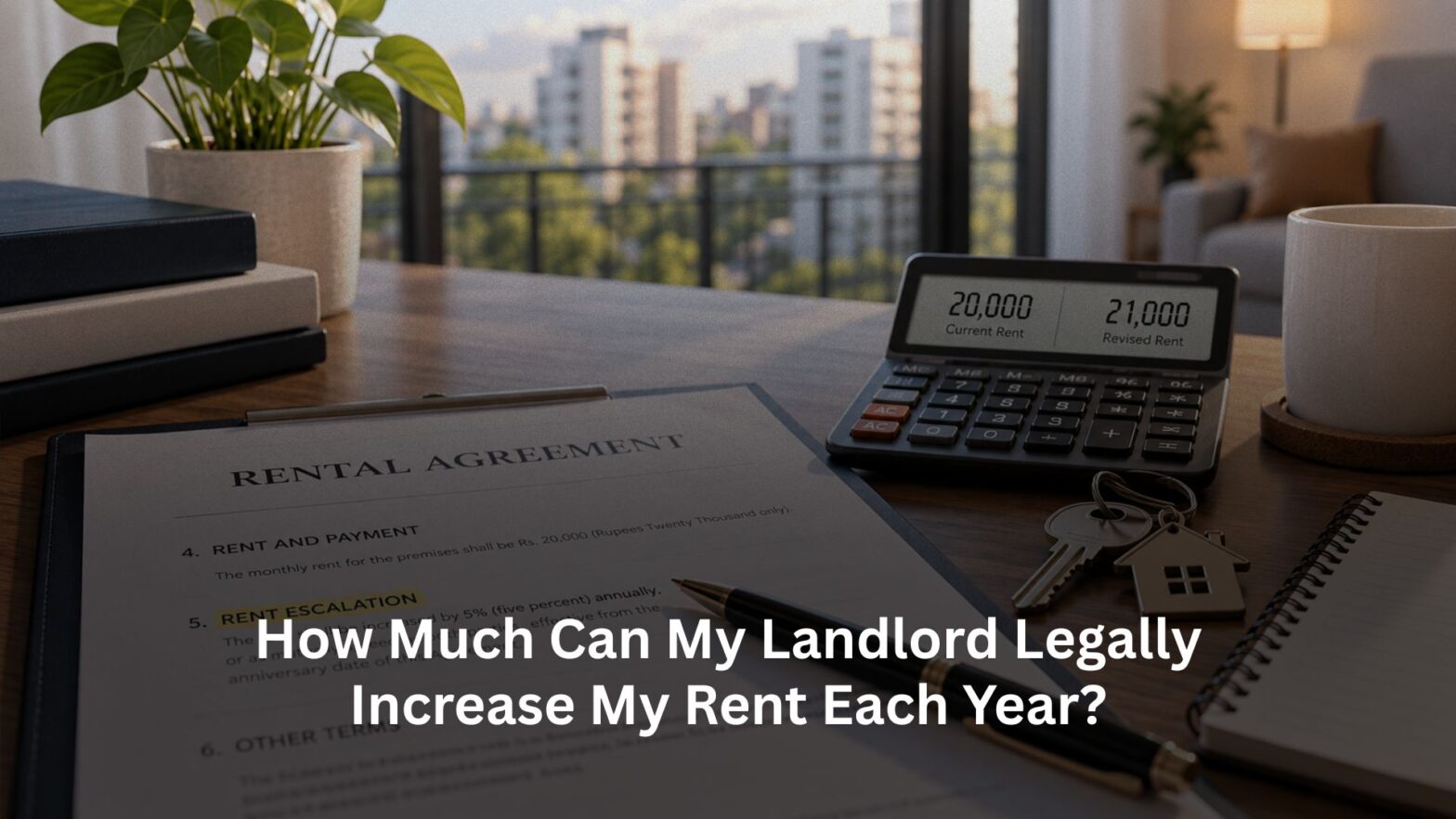
How Much Can My Landlord Legally Increase My Rent Each Year?
Rent increases are a normal part of many rental arrangements. Property owners face rising maintenance costs, higher utility expenses, and changing market conditions. Tenants, however, need financial stability. An unexpected rent hike can affect their monthly budget, savings, and decision to continue living in the property.
This creates an important question: How much can a landlord legally increase rent each year in India?
Many tenants believe that landlords can increase rent by 10% every year. Others assume that every rent increase is illegal unless the tenant agrees again. Both assumptions can be misleading.
India does not have one universal annual rent increase percentage that applies to every rental property. The applicable rule depends on the rental agreement, the state’s tenancy laws, and the type of property involved.
For example, some agreements include an annual escalation clause. Others allow rent revision only during renewal. Certain rent-controlled properties may follow specific statutory limits. Therefore, tenants and landlords must examine the terms that apply to their particular arrangement.
This guide explains rent increase rules in India, escalation clauses, notice requirements, and negotiation strategies. It also highlights how clear documentation can reduce disputes between landlords and tenants.
Is There a Legal Cap on Rent Hikes in India?
There is no single nationwide annual cap on rent hikes for every private rental arrangement in India. In most cases, rent revision depends on the rental agreement, which may specify the increase, timing, and applicable conditions.
The Model Tenancy Act, 2021 provides a framework for rental relationships, but it is a model framework and does not automatically replace the tenancy laws of every state. Therefore, rent rules can vary across jurisdictions.
For example, Section 6A of the Delhi Rent Control Act, 1958 permits a 10% rent increase every three years for premises covered by the provision. This does not mean landlords can increase rent by 10% every year.
Before increasing or challenging rent, consider:
- Rental agreement: Check the escalation or renewal clause.
- Property type: Rules may differ for flats, PGs, hostels, and rent-controlled premises.
- State laws: Local tenancy legislation may impose specific requirements.
- Timing: An increase during the tenancy may differ from one at renewal.
- Disputes: Challenged increases may require the applicable dispute-resolution process.
Landlords should not assume that any annual percentage is automatically permitted, while tenants should check their agreement and applicable local law before disputing a rent hike.
For a broader understanding of rental laws, you can explore RentOk’s guide on What Is Rent Control Law in India, and Which Cities Are Still Covered?
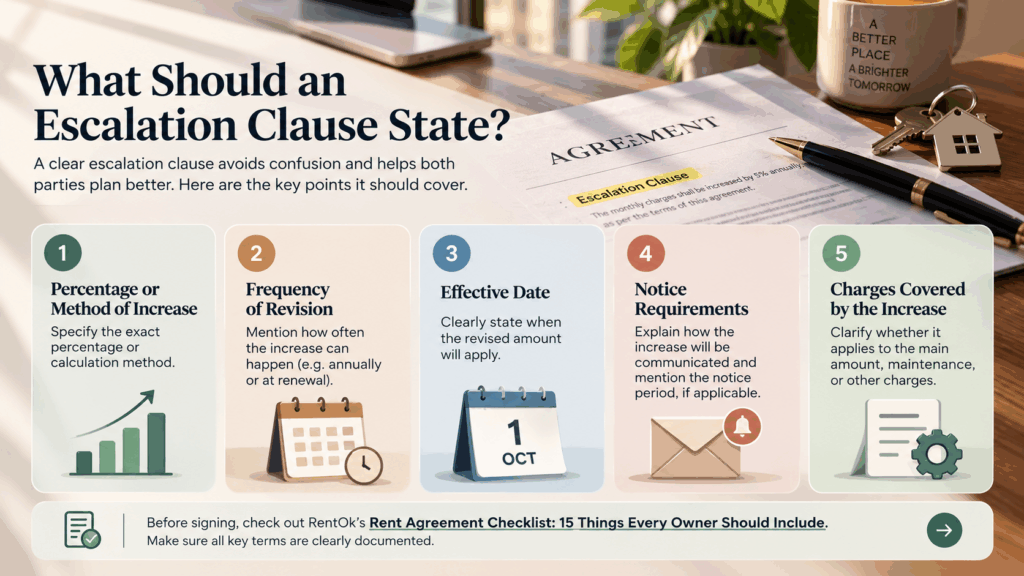
What Should a Rent Escalation Clause State?
A rent escalation clause explains how and when the rent may increase. It should be specific enough for both parties to understand their financial obligations.
A vague clause can create confusion. For example, a statement such as “rent may increase as required” does not clearly explain the percentage, timing, or process. The tenant may interpret the clause differently from the landlord.
A well-written escalation clause should address the following points.
1. Percentage or Method of Increase
The clause should state the exact percentage or calculation method. If the increase depends on another factor, the agreement should explain that factor clearly.
For example, an agreement may state that rent will increase by 5% after the completion of 12 months. It should also clarify whether the increase applies to the base rent alone or includes maintenance charges.
2. Frequency of Revision
The agreement should explain how often rent can be revised. Common arrangements may include an increase every year or a revision at the time of renewal.
The frequency must not be assumed. A clause that allows revision once every 12 months is different from one that allows revision only when the agreement is renewed.
3. Effective Date
The agreement should mention when the revised rent will become applicable.
For example, if the tenancy begins on 1 October, the clause may provide for a revision from 1 October of the following year. A clear date helps both parties plan their payments.
4. Notice Requirements
The clause should explain how the landlord will communicate the proposed increase. It should also mention the notice period, if applicable.
Written communication is preferable. It creates a record of the revised amount and the date from which it will apply.
5. Charges Covered by the Increase
The agreement should clarify whether the escalation applies to rent, maintenance, or other charges.
In PGs and co-living properties, tenants may pay for services such as food, housekeeping, electricity, and internet. These charges should not be combined without explanation.
Before signing, tenants can also review RentOk’s Rent Agreement Checklist: 15 Things Every Owner Should Include. The checklist covers important terms that should be documented in a rental agreement.
What Is the Typical Annual Rent Increase Percentage in India?
There is no fixed annual rent hike percentage that applies to every property in India. The amount depends on the local rental market, the agreement, and the legal framework applicable to the tenancy.
Some landlords and tenants mutually agree to a yearly increase of 5%. Others may agree to a different percentage based on location, property type, services, and expected costs. These figures represent possible contractual arrangements. They should not be treated as universal legal limits.
Consider the following example:
A tenant pays ₹20,000 per month. The agreement includes a 5% annual escalation clause.
- Current monthly rent: ₹20,000
- Annual increase: 5%
- Increase amount: ₹1,000
- Revised monthly rent: ₹21,000
The calculation is simple. However, the increase must also follow the agreement’s timing and other conditions.
The financial impact becomes more significant when additional charges increase alongside rent. A tenant may face a higher monthly payment if maintenance, electricity, food, or service charges are revised at the same time.
This is why tenants should ask for a complete breakdown before accepting a revised amount.
Questions to Ask Before Accepting a Rent Increase
- Is the proposed increase mentioned in the existing agreement?
- Does the increase apply to rent alone or to other charges as well?
- Is the increase being introduced during the agreement or at renewal?
- Has the landlord provided written communication?
- Are the revised charges supported by the agreed calculation method?
- Can the tenant request a discussion before the revised amount takes effect?
A landlord may have genuine reasons for reviewing rent. At the same time, tenants deserve clarity about how the new amount has been calculated.
For more guidance, read RentOk’s How to Negotiate Rent and Maintenance Terms Before Signing. Understanding the financial terms before signing can reduce disagreements later.
Does a Landlord Have to Give Notice Before Increasing Rent?
The notice required before a rent increase depends on the agreement and the law applicable to the property.
Some rental agreements specify a notice period for rent revision. Others explain that the revised rent will apply from the next renewal date. If the agreement does not address the issue, the relevant state law and legal principles may become important.
A landlord should not assume that sending a message immediately before collecting the revised rent is always sufficient. The tenant should have a clear understanding of the proposed change and its effective date.
Written notice should ideally include:
- The current rent and the revised rent.
- The percentage or amount of the increase.
- The date from which the new rent will apply.
- The clause or legal basis supporting the revision.
- Any change in maintenance or additional service charges.
- The deadline for the tenant to respond, where relevant.
Some state laws may prescribe specific notice requirements. For instance, provisions in certain tenancy laws address notice when the agreement does not specify a rent revision process. These rules are not identical across India.
Therefore, landlords and tenants should verify the applicable state requirements instead of relying on general online advice.
Clear communication also protects the landlord’s records. A written notice can help establish when the tenant was informed and what amount was requested.
Can Rent Be Increased During an Ongoing Agreement?
Whether rent can increase during an ongoing agreement depends on the contract and applicable law.
A fixed-term agreement may state that rent will remain unchanged for the entire term. Another agreement may include a clause allowing a specific increase after a defined period.
If the contract contains a valid escalation clause, the landlord may be able to revise rent according to that clause. The increase must still follow the agreed conditions and any applicable legal requirements.
However, a landlord should not assume that rent can be increased at any time simply because market prices have risen.
For example, a tenant signs a 12-month agreement with a fixed monthly rent. The agreement does not include an escalation clause. After six months, the landlord asks for a 15% increase.
The tenant can review the agreement and ask for the contractual basis of the demand. The outcome will depend on the facts, the agreement, and the applicable law.
The situation may be different when the agreement reaches its end. At renewal, both parties may discuss new rent and other terms. The tenant can decide whether the revised terms are acceptable before entering into a new arrangement, subject to applicable legal protections.
RentOk’s Rent Agreement Renewal: When and How to Update Terms explains why renewal is an important opportunity to review rent, notice periods, maintenance, and other contractual conditions.
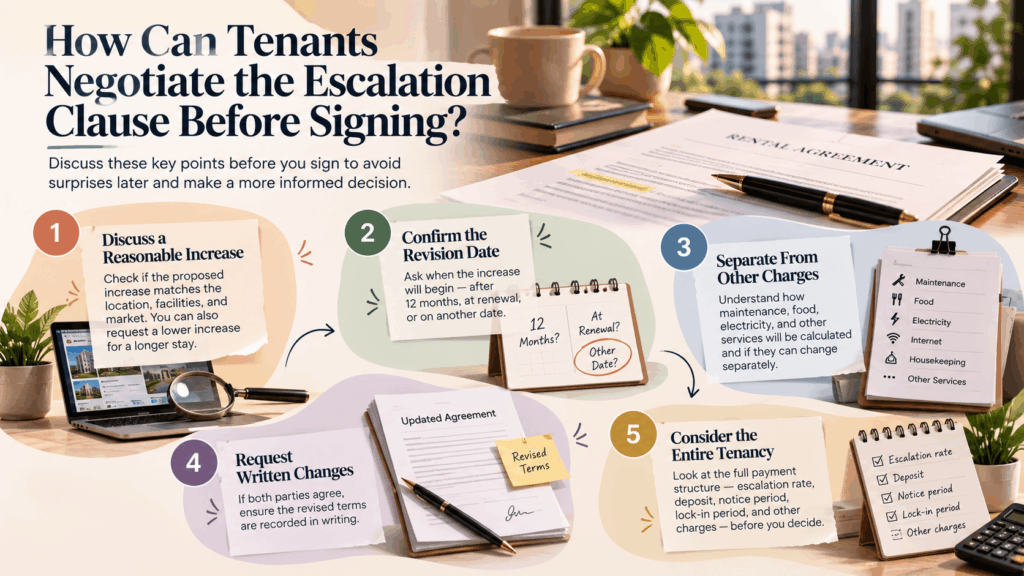
How Can Tenants Negotiate the Escalation Clause Before Signing?
Negotiating the rent escalation clause before signing is often easier than disputing an unclear increase later.
Tenants should not focus only on the starting rent. They should also consider how the amount may change during the tenancy.
A clause that appears manageable in the first year may become expensive over a longer period. Understanding the full payment structure can help tenants make informed decisions.
Discuss a Reasonable Increase
Tenants can ask whether the proposed percentage reflects the property’s location, facilities, and rental market. They may also request a lower increase if they plan to stay for a longer period.
Landlords can explain the costs that influence the proposed revision. These may include maintenance, repairs, staffing, utilities, and property improvements.
The discussion should focus on clear terms rather than informal promises.
Confirm the Revision Date
Ask when the escalation will begin. A tenant should know whether the increase starts after 12 months, at renewal, or on another specified date.
The agreement should also clarify whether the calculation is based on the original rent or the already revised rent.
Separate Rent From Other Charges
In a PG or co-living arrangement, rent may be only one part of the monthly payment. Ask how maintenance, food, electricity, and other services will be calculated.
If these charges can change, the agreement should explain the process. This makes the total monthly cost easier to estimate.
Request Written Changes
If both parties agree to a change, the revised term should be recorded in writing.
A verbal promise may be difficult to establish later. Written amendments, updated agreements, or clearly documented confirmations provide a more reliable reference.
Consider the Entire Tenancy
A lower starting rent may not always result in a lower total cost. Tenants should consider the escalation rate, deposit, notice period, lock-in period, and additional charges together.
Landlords can also benefit from this approach. Clear terms help them communicate expectations and reduce repeated negotiations.
What Can Tenants Do If a Rent Increase Seems Unfair?
A tenant who receives an unexpected rent increase should first review the agreement. The relevant clause may explain whether the increase is allowed and when it can take effect.
The tenant can then request written clarification from the landlord. The request should remain factual and should identify the specific concern.
Useful steps include:
- Review the agreement: Check the rent, escalation clause, renewal terms, and notice requirements.
- Ask for a calculation: Request a breakdown of the revised rent and any additional charges.
- Communicate in writing: Keep a record of messages, emails, notices, and responses.
- Check local law: Confirm whether state-specific rules apply to the property.
- Seek appropriate advice: If the dispute continues, consult a qualified legal professional or the relevant authority.
Tenants should avoid making assumptions based only on the percentage of the increase. The legal position depends on the complete situation.
Landlords should also maintain proper records. Agreements, payment receipts, notices, and amendments can help establish the history of the tenancy.
How RentOk Helps Landlords Manage Rent Escalation More Clearly
RentOk helps property owners manage rental operations through structured digital records and property-management tools. For landlords managing PGs, hostels, or multiple rental properties, maintaining consistent tenant information and payment details can support clearer communication. Rent escalation terms can be documented as part of the broader agreement and tenant-management process. This reduces dependence on scattered messages, spreadsheets, and manual follow-ups. Owners can also use RentOk’s property-management blog resources and official YouTube channel to explore practical guidance on rental operations, documentation, and tenant management.
Conclusion
A landlord cannot automatically increase rent by any percentage every year across all properties in India. The applicable rules depend on the rental agreement, local tenancy laws, property type, and timing of the revision.
Tenants should read the escalation clause before signing. Landlords should communicate increases clearly and follow the agreed process. Both parties should document changes to avoid confusion later.
A well-defined rent escalation clause creates clarity from the beginning. It explains the percentage, revision date, notice process, and charges covered by the increase.
Set Clear Rent Escalation Terms with RentOk and make rental management more transparent, organised, and easier to handle.
FAQ’S
1. Can a landlord charge the increased amount from an earlier date?
Generally, a rent increase should apply from the date specified in the agreement or applicable legal provision. A landlord should not assume that a revised amount can be applied retrospectively without a valid basis.
2. Can rent be increased because property prices have gone up?
Rising market prices may be a reason for a landlord to seek a higher amount, but they do not automatically create a legal right to increase it. The agreement and applicable tenancy rules still matter.
3. Does a rent increase also increase the security deposit?
Not necessarily. The security deposit and monthly rent are separate terms unless the agreement links them. Any change to the deposit should be checked against the agreement and applicable local rules.
4. Can a landlord increase the rent after the agreement expires?
Once the existing agreement ends, the parties can discuss new terms for a renewed tenancy, subject to applicable law. A revised amount may therefore be proposed as part of the new agreement.
5. What happens if there is no written rental agreement?
Without a written agreement, proving the exact terms of the tenancy can become more difficult. Rent receipts, payment records, messages, and other documents may become important in establishing the arrangement.
6. Can a tenant refuse to accept a revised rent amount?
A tenant can question or dispute a proposed increase if they believe it does not follow the agreement or applicable law. If the disagreement continues, the appropriate legal or dispute-resolution process may depend on the state and property involved.