
Digital KYC and Police Verification: State-wise Compliance in India
Tenant onboarding in most PGs still follows an informal pattern. A tenant walks in, shares an ID proof over WhatsApp, fills in a few details, and moves in almost immediately. At first glance, this process seems efficient. However, when you examine it from a compliance perspective, it becomes clear that it is incomplete.
Today, onboarding is no longer just an operational step, it is a legal and structural responsibility. As cities become more regulated and enforcement becomes stricter, authorities increasingly expect landlords to maintain verified, traceable tenant records. Therefore, digital KYC and police verification are not additional steps; instead, they form the foundation of responsible property management.
Why Tenant Verification Has Become Non-Negotiable
Earlier, landlords treated verification as a precaution. However, over time, it has evolved into a core operational requirement. This shift has not happened suddenly; rather, it reflects growing concerns around safety, accountability, and traceability in shared living spaces.
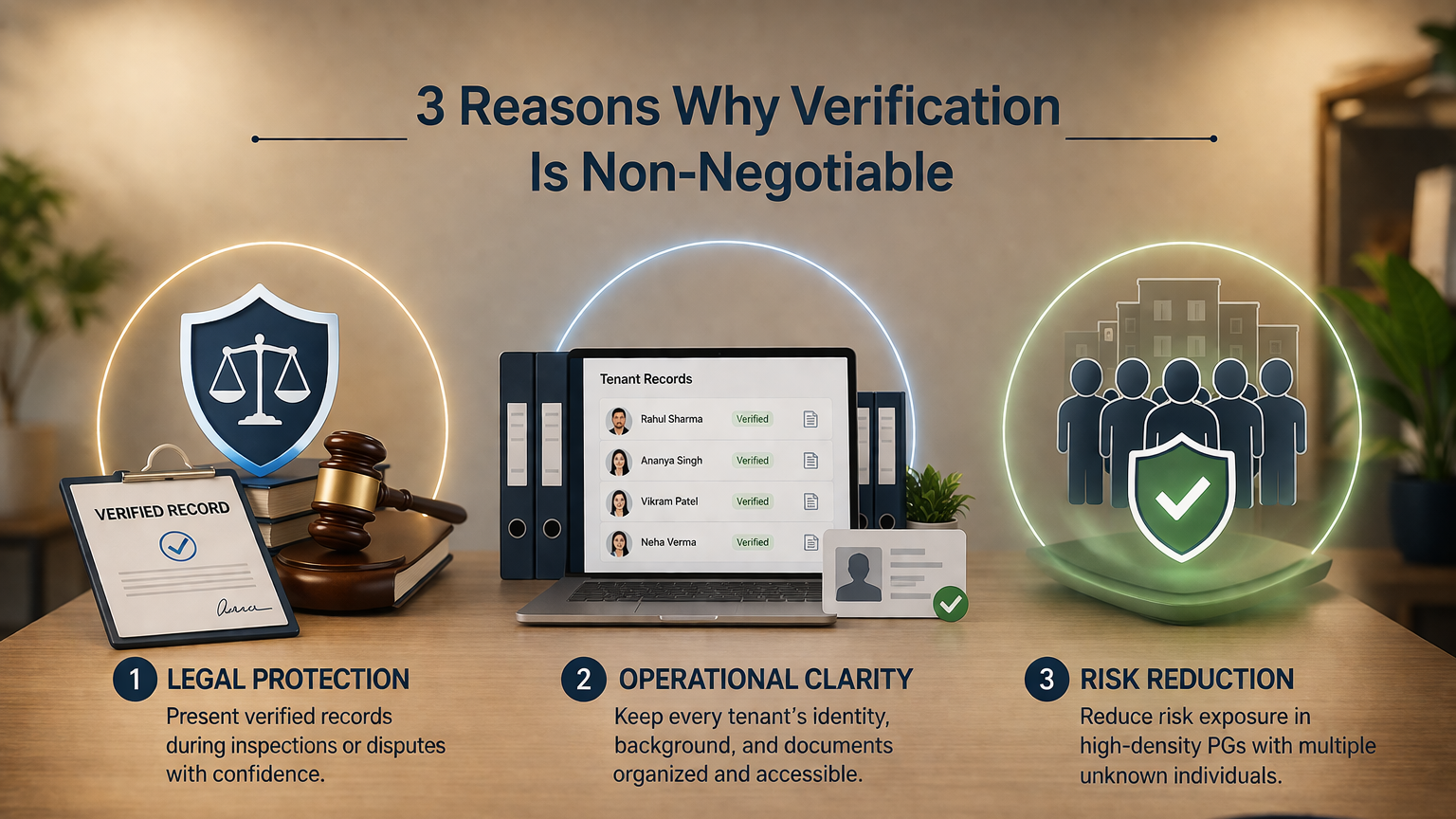
When you implement structured verification, three things happen simultaneously:
- First, you strengthen legal protection, because you can present verified records during inspections or disputes without scrambling for documents at the last minute
- Second, you improve operational clarity, since every tenant’s identity, background, and documentation remain organized and accessible in one place
- Finally, you reduce risk exposure, especially in high-density PGs where multiple unknown individuals share infrastructure and resources
As a result, verification is no longer about compliance alone, it directly impacts how stable and secure your operations are.
Legal Necessity: What Is Actually Expected From You
Although India does not follow a single unified law for tenant verification, the expectation across states remains broadly consistent. Local authorities require landlords to maintain proper tenant records and complete verification within defined timelines.
In practical terms, this involves:
- Collecting valid identity proof and verifying its authenticity, ensuring that the person occupying the property matches official documentation and is not misrepresented
- Maintaining complete tenant profiles, including permanent address, contact information, and occupation, so that records are not fragmented or incomplete
- Submitting tenant details for police verification, either through online portals or local police stations, depending on the city’s system
Importantly, these are not optional guidelines. Instead, authorities treat them as baseline responsibilities, and therefore, ignoring them creates compliance gaps that can surface unexpectedly.
State-Wise Compliance: Why One Process Does Not Fit All
One of the most overlooked realities in India’s rental ecosystem is that compliance is highly localized. Many operators assume that a single verification method works everywhere. However, this assumption often leads to mistakes.
In reality, each state, and sometimes each city, follows its own system. Consequently, operators must adapt based on location rather than relying on a standardized national approach.
You will typically encounter:
- Fully digital systems, where you upload tenant details, submit documents, and receive acknowledgment online, making the process faster but also more structured
- Hybrid systems, where you initiate verification digitally but still need to visit a police station for final submission or confirmation
- Manual systems, where authorities require physical forms along with printed documents, which increases dependency on paperwork and timelines
Therefore, compliance is not about knowing the rule, it is about knowing which version of the rule applies to your property.
Digital KYC: From Document Collection to Data Structuring
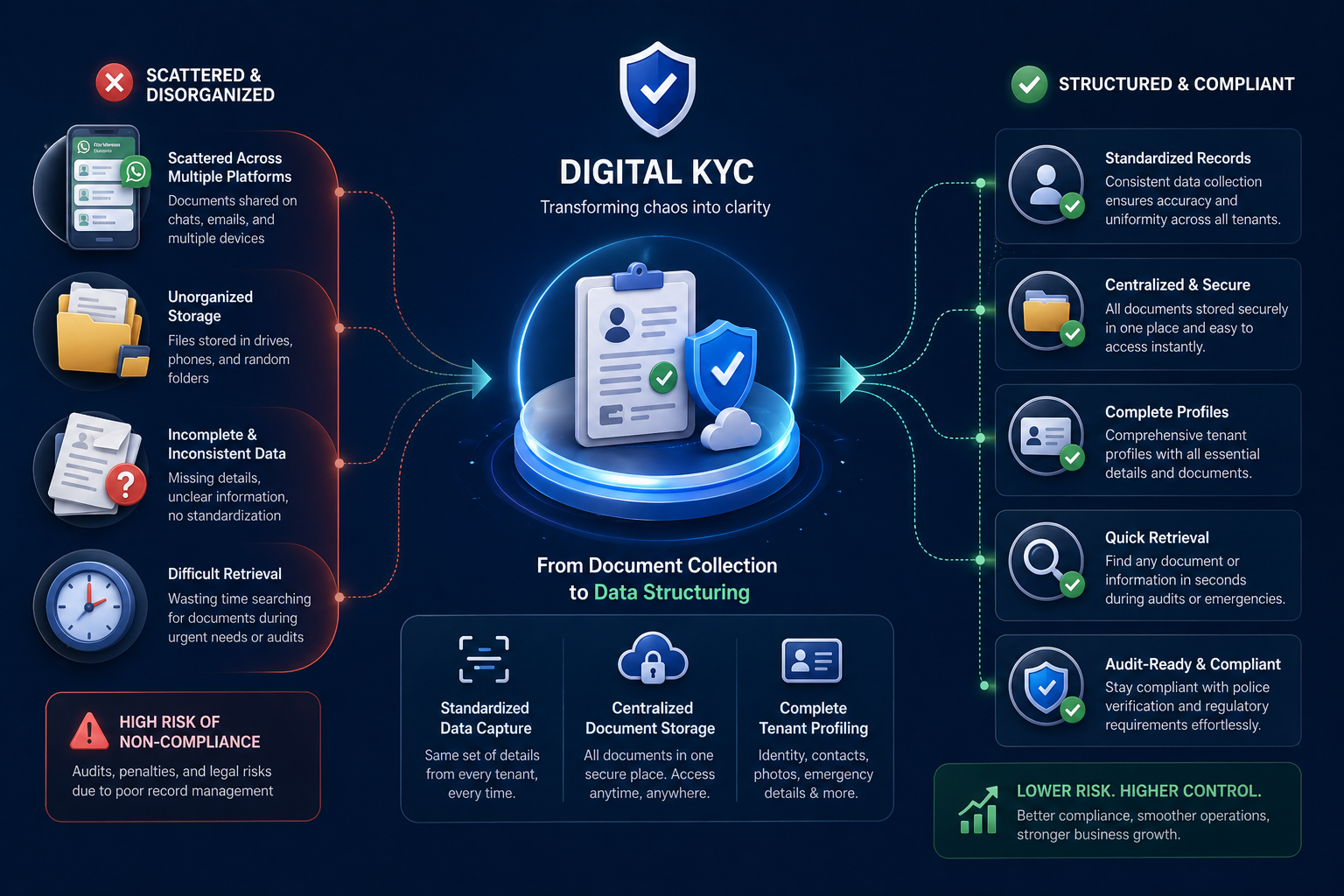
Most PG operators already collect documents. However, the real issue lies in how those documents are handled afterward.
In many cases:
- Files are stored across phones, drives, or chats
- Data is incomplete or inconsistent
- Retrieval becomes difficult when needed urgently
Digital KYC addresses this by transforming scattered information into a structured system.
A proper digital KYC process includes:
- Standardized data capture, where every tenant submits the same set of required details, ensuring consistency across records
- Centralized document storage, which allows you to access tenant information instantly instead of searching across multiple platforms
- Complete profiling, including identity proof, contact details, and supporting information like photographs and emergency contacts
As a result, KYC shifts from passive storage to active data management, which is essential for scaling operations.
Police Verification: The Step That Breaks Without a System
Even when operators collect KYC documents correctly, they often delay or skip police verification. This usually happens because there is no system to track timelines or ensure completion.
However, police verification is not optional, it formalizes your tenant records and connects them to official databases.
It plays a critical role because:
- It establishes an official record of occupancy, which becomes important during inspections or disputes
- It verifies tenant background, reducing the risk of unknown individuals staying in your property
- It protects you legally, especially when authorities require proof of compliance
Without a system, verification becomes inconsistent. With a system, it becomes predictable.
The Real Challenge: Scaling Without Structure
Manual processes may work when tenant volume is low. However, as your PG grows, complexity increases rapidly.
You begin to deal with:
- Multiple move-ins and move-outs happening simultaneously
- Different verification timelines for each tenant
- Documents stored in scattered formats
As a result, predictable problems emerge:
- Incomplete documentation, where some tenants have full records while others do not
- Missed submission timelines, because no system tracks verification status
- Difficulty retrieving data, especially during urgent situations like inspections
At this stage, effort is not the problem, lack of structure is.
Automating Data Collection: Making Compliance Scalable
To handle verification efficiently, you must integrate it into onboarding instead of treating it as a follow-up task.
A structured system ensures:
- Document submission happens before move-in, so no tenant enters the property without completing required formalities
- Data is captured in a standardized format, eliminating inconsistencies across tenants
- All records are stored centrally, allowing instant access whenever required
This approach fundamentally changes operations.
Instead of reacting to missing data, you ensure:
Compliance is completed before occupancy begins.
Common Mistakes That Lead to Compliance Gaps
Even experienced operators face compliance issues, not because they lack awareness, but because execution remains inconsistent.
Some recurring mistakes include:
- Fragmented record-keeping systems, where documents exist but remain scattered across devices, making them unreliable during audits
- No tracking mechanism for verification status, which leads to confusion about which tenants have completed police verification
- Allowing move-ins before documentation is complete, creating backlog and increasing the risk of non-compliance
- Absence of standardized onboarding processes, resulting in uneven data collection across tenants
Over time, these gaps accumulate. Individually, they seem manageable. Collectively, they create serious operational and legal risks.

How Rentok Helps You Manage KYC and Verification at Scale
As tenant volume increases, maintaining compliance manually becomes difficult to sustain. This is where a structured platform like Rentok becomes critical.
With Rentok, you can maintain a centralized system where tenant onboarding, document collection, and record management are integrated into one workflow. Instead of relying on scattered tools or manual tracking, all tenant data is organized, accessible, and consistently maintained.
This allows you to:
- Ensure that every tenant record is complete and standardized across your property
- Store KYC documents securely with instant access whenever required
- Maintain clarity on tenant information without switching between multiple systems
- Reduce dependency on manual processes that often lead to gaps
By bringing structure to tenant data, Rentok helps you move from reactive compliance to a system where verification is built into your operations.
Conclusion
Digital KYC and police verification are no longer administrative tasks that can be handled casually. Instead, they define how compliant, organized, and scalable your PG operations are.
Most compliance issues do not arise from complex regulations. Rather, they come from unstructured systems, inconsistent processes, and missing records. Once you introduce structure into onboarding and verification, compliance becomes significantly easier to manage.
If your current system still relies on manual tracking and scattered documentation, gaps already exist, even if they are not visible yet.
Explore RentOk to streamline your tenant onboarding, centralize your records, and build a system where compliance happens naturally as part of your operations.