
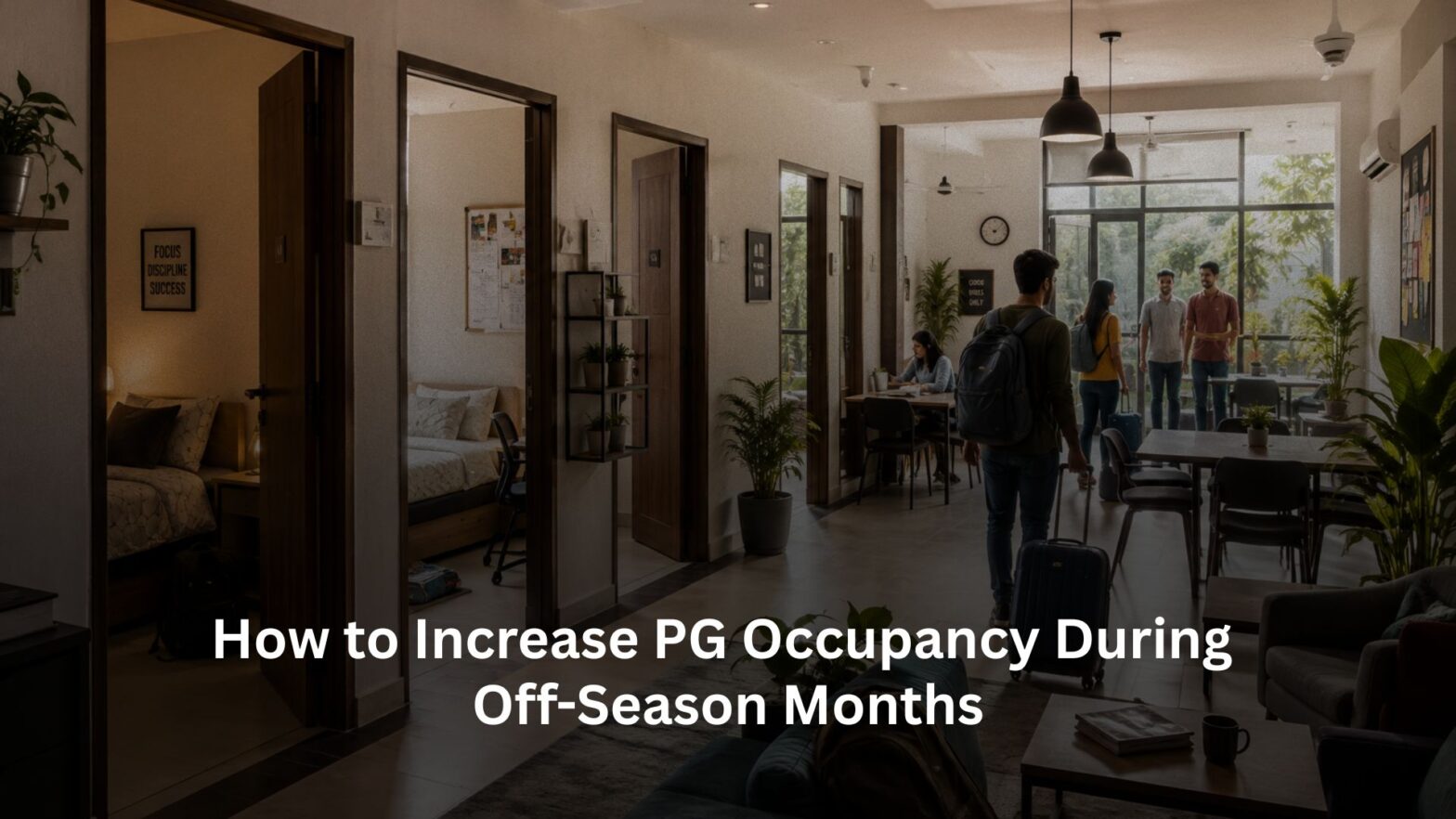
How to Increase PG Occupancy During Off-Season Months
For most PG operators, occupancy feels easy when the academic or corporate rental cycle is at its peak. Inquiries are regular, visits are happening, and beds can get booked without requiring aggressive marketing. The real challenge begins when that demand naturally slows down.
January-February and May-June can be particularly difficult for student-focused PGs because of academic breaks, examinations, vacations, course completions, and shifting cycles. A few empty beds may not seem alarming initially, but when those vacancies continue for several weeks, the impact goes beyond lost rent. Property expenses, staff salaries, housekeeping, food, utilities, and maintenance continue even when a room remains unoccupied.
This is why off-season occupancy should not be treated as an unexpected problem. For many properties, it is a predictable part of the rental cycle. The operators who handle it well are not necessarily the ones offering the biggest discounts. They are the ones who understand when demand will soften and start preparing before the beds become vacant.
If you are planning growth beyond simply filling vacant beds, you can also read How to Grow Your PG Business in 2026, which looks at occupancy, pricing, tenant experience, and systemisation as connected parts of PG growth.
Why Does PG Occupancy Drop During the Off-Season?
The first thing operators need to understand is that a seasonal occupancy drop does not automatically mean the property has become less attractive. Sometimes, the market itself changes.
Students may return home during academic breaks. Graduates may move out after completing their courses. Working professionals may postpone relocation around holidays or financial cycles. In some locations, the number of people actively searching for accommodation simply falls for a few weeks.
The mistake is treating every vacant bed as the same problem.
Before changing your pricing or spending more on advertising, identify what is actually causing the vacancy. A few questions can reveal where the problem lies:
- Are searches and inquiries falling across the entire market, or is your property receiving fewer inquiries than competitors? If the entire area is seeing weaker demand, the strategy needs to focus on alternative tenant segments and advance demand generation rather than simply changing your listing.
- Are people viewing your property but not contacting you? This could point toward weak photographs, unclear pricing, incomplete property information, or a listing that does not communicate enough value to make someone take the next step.
- Are inquiries coming in but not becoming bookings? In that case, the issue may be response time, follow-up, pricing, availability, or friction in the booking process rather than a lack of demand.
- Are existing tenants leaving at the same time? If seasonal vacancies are combined with higher tenant turnover, the property is dealing with pressure from both sides and needs to address retention as well as acquisition.
The distinction is important because running more advertisements will not fix poor conversion, just as reducing rent will not fix poor visibility.

Start Building Demand Before the Beds Become Empty
One of the most common mistakes in PG marketing is waiting for vacancy before starting the marketing process.
An owner sees five beds becoming vacant, uploads a few posts, contacts a broker, and starts offering discounts. By that point, the property is competing for a limited pool of tenants who are already comparing multiple options.
A stronger approach is to work backwards from the expected vacancy period. If May and June are historically slower for your property, April should not be the month when your occupancy strategy begins. Your listing, photographs, reviews, referral activity, lead database, and booking process should already be prepared.
This is where occupancy planning becomes more useful than reactive marketing. Instead of asking, “How do I fill these empty beds?”, an operator should be asking, “How many beds are likely to become available, when will they become available, and which tenant segments can realistically fill them?”
That change in thinking creates a much healthier pipeline.
You can also internally link this section to How to Improve Occupancy Rate in PG, since the existing RentOk article covers the broader factors behind occupancy, including pricing, digital visibility, reviews, referrals, inquiry management, and occupancy tracking.
Make Your Property Listing Work Harder
During peak season, strong demand can sometimes compensate for an average listing. During the off-season, it cannot.
Your online listing is often the first interaction a prospective tenant has with your property. Before they call, visit, or ask a question, they are already judging the room photographs, location, pricing, amenities, reviews, and overall presentation.
A good listing should answer the questions a prospect would otherwise need to ask over a call. Recent photographs should show the actual condition of rooms and common areas. Pricing should be clear enough to prevent unnecessary back-and-forth. Amenities should be explained in terms of what they mean for daily living, rather than simply presented as a long checklist.
Location also needs to be positioned properly. A PG near a college should communicate its proximity to that college. A property serving working professionals should highlight access to business districts, metro stations, transport, and everyday conveniences.
During slower months, your listing should do more than announce that a bed is available. It should give a prospective tenant enough information to understand why that bed is worth booking.
Use Pricing as a Demand Lever, Not a Panic Button
When occupancy falls, reducing rent is often the first reaction. Sometimes it works. But reducing prices across the board can also reduce revenue without solving the real problem.
The better approach is to understand what is preventing the tenant from booking.
If prospects are interested but hesitant because of upfront costs, a limited-period joining benefit or a more flexible payment structure may be more effective. If your property is competing with similar PGs, adding value through an amenity or service may improve the overall offer without permanently reducing monthly rent.
The objective should not be to become the cheapest PG in the neighbourhood. It should be to become a more compelling option for the tenant you actually want to attract.
That also makes it important to understand the occupancy level at which your property remains financially sustainable. How to Calculate Your PG’s Break-Even Occupancy is a useful next read when evaluating occupancy from a profitability perspective.
Pricing should therefore be treated as a business decision based on occupancy, competition, demand, and tenant behaviour, not as an emergency response every time a bed becomes vacant.
Look Beyond Your Usual Tenant Segment
Seasonal occupancy becomes much easier to manage when a PG is not completely dependent on one category of tenant.
A student-focused property may see weaker demand during academic breaks, but that does not mean every potential tenant disappears. Depending on the location, off-season demand can come from interns, trainees, working professionals, exam aspirants, students joining coaching programmes, or people relocating temporarily for work.
The key is to identify which groups still have a reason to move during the period when your regular audience is less active.
Your existing tenant base can provide useful clues. If several residents have previously come through internships, nearby companies, coaching centres, or short-term academic programmes, those networks may be worth targeting during slower months.
The messaging should change with the audience too. Someone looking for a room for a two-month internship has a different decision-making process from a student looking for accommodation for an entire academic year. Matching the offer to the tenant’s actual requirement can improve conversion without requiring a completely different property.
Re-Activate Old Leads Before Spending More on New Ones
When occupancy drops, operators often immediately look for more leads. But before increasing advertising spend, look at the leads you already generated.
Someone who contacted your PG three months ago but didn’t book isn’t necessarily a dead lead. Their joining date could have changed, the room they wanted may not have been available, or their plans might simply have been postponed.
Old leads can be re-engaged based on why they did not convert in the first place.
- Timing-related leads can be contacted when availability becomes relevant again, especially when their original requirement was genuine but the move-in date did not work.
- Price-sensitive leads can be approached when a relevant offer becomes available, rather than sending the same discount message to everyone in your database.
- Unresponsive leads can receive a useful availability update, including current room options, pricing, photographs, and joining dates instead of another generic follow-up asking whether they are still looking.
The important part is organisation. If lead details are scattered across WhatsApp conversations, notebooks, calls, and spreadsheets, it becomes difficult to know who should actually be followed up with.
You can naturally link this section to Top 5 Sources to Get Tenant Leads in India, where RentOk discusses Google, listing portals, WhatsApp groups, social media, referrals, and brokers as different acquisition channels.

Let Existing Tenants Become Part of Your Growth Strategy
Your current residents can be one of the most useful sources of off-season demand.
A tenant who is happy with the property may know a classmate, colleague, friend, or relative who is looking for accommodation. That recommendation carries something an advertisement cannot easily create: trust based on personal experience.
A referral programme can make this process more consistent. The incentive does not have to be excessive. What matters is that residents understand how the referral works, what qualifies, and when the reward is provided.
However, referrals cannot compensate for a poor tenant experience. If residents regularly deal with unresolved complaints, inconsistent cleanliness, or poor communication, they are unlikely to recommend the property regardless of the incentive.
This is why occupancy growth and tenant experience are closely connected. A property that manages its existing residents well creates a natural acquisition channel at the same time.
Tenant experience therefore becomes part of your occupancy strategy, not just a post-booking responsibility. For more on this connection, see Creating a Better Living Experience with a PG App.
Make Booking Easy When a Lead Is Ready
Getting an inquiry is only half the job. The real opportunity is converting that inquiry while the prospect is still actively looking.
A tenant may discover your PG at night, compare it with other properties, and decide to reserve a room. If they have to wait until the next day for confirmation, the opportunity may disappear. Multiple calls to check availability can also create unnecessary friction.
A smoother booking journey makes the process simple. Prospects should be able to view available options, schedule a visit, and move toward reservation with ease.
It is equally important for the operator to know which beds are already committed. A confirmed booking represents future occupancy, but only if that information is recorded correctly.
RentOk’s existing article, How to Track Booking and Upcoming Tenants, explains why tracking future tenants matters. It helps prevent double bookings, prepare rooms before arrival, manage joining dates, and plan upcoming occupancy.
This becomes particularly valuable during off-season months because every confirmed booking matters more when overall inquiry volume is lower.
Keep Your Property Visible Even When Demand Is Low
Off-season should not mean disappearing from the market.
In fact, consistent visibility becomes more important when demand is weaker. If your property stops appearing across search, listing platforms, social media, and local communities, potential tenants may simply never know that rooms are available.
The content does not need to become heavily promotional. Show actual rooms, property improvements, tenant experiences, location advantages, amenities, and current availability. A simple room walkthrough or an honest look at the property can often communicate more than a highly designed promotional post.
A quieter period is also a good time to improve your digital presence before the next peak season. Update old photos, collect genuine tenant reviews, refresh your property descriptions, and make your contact and booking details easy to find.
You can also link to RentOk’s Cost Per Lead for PGs: Are Your Ads Worth It?. It can help readers understand the difference between generating leads and achieving profitable occupancy.
Track the Numbers Behind Your Occupancy
Occupancy should be measured as a business metric, not just a number someone checks at the end of the month.
An operator should know how many beds are vacant, how long they have remained vacant, where inquiries are coming from, how quickly those inquiries are being handled, and how many eventually become bookings.
A few metrics can provide a much clearer picture:
- Occupancy rate by month shows seasonal patterns, helping you identify whether January, February, May, or June consistently creates pressure and allowing you to prepare before the same pattern returns.
- Average vacancy duration tells you how quickly beds are being filled, which is often more useful than looking at occupancy alone because two properties can have the same occupancy while one fills vacancies significantly faster.
- Lead-to-booking conversion shows whether your marketing is actually working, rather than allowing high inquiry numbers to create a false sense of performance.
- Channel-wise performance reveals where your strongest tenants come from, helping you decide whether your time and budget should go toward listings, referrals, Google, social media, brokers, or direct inquiries.
Once these numbers are visible, off-season planning becomes less dependent on instinct. You can see where the actual gaps are and make decisions accordingly.
Use the Off-Season to Prepare for the Next Peak
The off-season should not only be viewed as a period where you try to minimise losses. It can also be the best time to prepare the property for the next demand cycle.
Use quieter months to improve rooms, fix recurring maintenance issues, update photographs, collect reviews, clean your lead database, train staff, and improve the booking journey. These changes may not immediately increase occupancy, but they remove friction when demand starts returning.
The strongest operators do not wait for the next admission cycle to begin preparing. They enter that cycle with updated listings, better reviews, organised lead information, clear availability, and a booking process that is ready to convert demand.
That preparation can make a significant difference when hundreds of prospective tenants begin searching within the same few weeks.

How RentOk Helps You Manage Off-Season Occupancy
Managing seasonal occupancy requires visibility across the entire journey, from a prospect discovering your property to that prospect becoming a confirmed booking and eventually moving in.
RentOk helps PG operators bring important parts of this process together. Operators can create professional property listings, manage inquiries, track bookings, monitor upcoming tenants, and maintain clearer visibility over occupancy. The platform’s property website can also showcase information such as photographs, facilities, rent, and availability while helping prospects schedule visits and reserve beds.
This becomes particularly useful during the off-season because the objective is not simply to generate more inquiries. It is to reduce the gap between discovery, inquiry, booking, and occupancy. When operators can see what is available, what has been booked, and which prospects are moving through the funnel, they can respond faster and plan ahead instead of relying on scattered conversations and manual records.
Conclusion: Make Seasonal Vacancy Predictable, Not Painful
Off-season vacancy is a recurring challenge for many PG businesses, but it does not have to become a recurring revenue problem. Seasonal demand may be outside an operator’s control, but preparation, visibility, lead management, pricing decisions, tenant referrals, and booking processes are not.
The goal is not to eliminate every seasonal fluctuation. It is to build a property operation that can absorb those fluctuations without immediately turning into empty beds and lost revenue.
Start building demand before vacancies appear. Keep your listing competitive. Re-engage old leads. Explore tenant segments that remain active. Make booking easier. Track where your occupancy is coming from and, most importantly, use the slower months to prepare for the next period of high demand.
Want to improve PG occupancy, manage bookings better, and keep your property ready for every demand cycle? Explore RentOk and discover smarter ways to manage your rental business.
FAQ’S
1. What is a good occupancy rate for a PG?
A healthy occupancy rate depends on the property’s location, tenant segment, pricing, and seasonal demand. Rather than focusing on one fixed number, operators should aim for consistently high occupancy while keeping vacancy periods as short and predictable as possible.
2. When should a PG owner start preparing for the next admission cycle?
Preparation should ideally begin several weeks before the expected increase in demand. Updating listings, organising availability, reconnecting with previous enquiries, and improving the booking process early can help the property convert demand faster when the next cycle begins.
3. Are discounts the best way to attract tenants during slow months?
Not necessarily. Discounts can help in specific situations, but operators should first understand what is preventing bookings. Limited-period offers, flexible joining benefits, or additional services can sometimes create stronger value without permanently reducing the property’s rental price.
4. How can PG owners know which marketing channel brings the best tenants?
Operators should track where each enquiry originates and follow its journey from initial contact to confirmed booking. Comparing conversion and acquisition costs across channels makes it easier to identify which sources are actually contributing to occupancy.
5. How long should a PG keep an unconverted lead?
There is no fixed expiry period for a lead, particularly when the prospect’s requirement is seasonal. Leads with a genuine future requirement can remain valuable for several months if their expected joining date, budget, and room preference are recorded for relevant follow-ups.
6. What can PG owners improve during months with lower demand?
Slower months can be used to improve the property before demand picks up again. Updating photographs, collecting reviews, resolving recurring maintenance issues, organising lead records, and improving the booking journey can all make the property more prepared for the next peak season.