
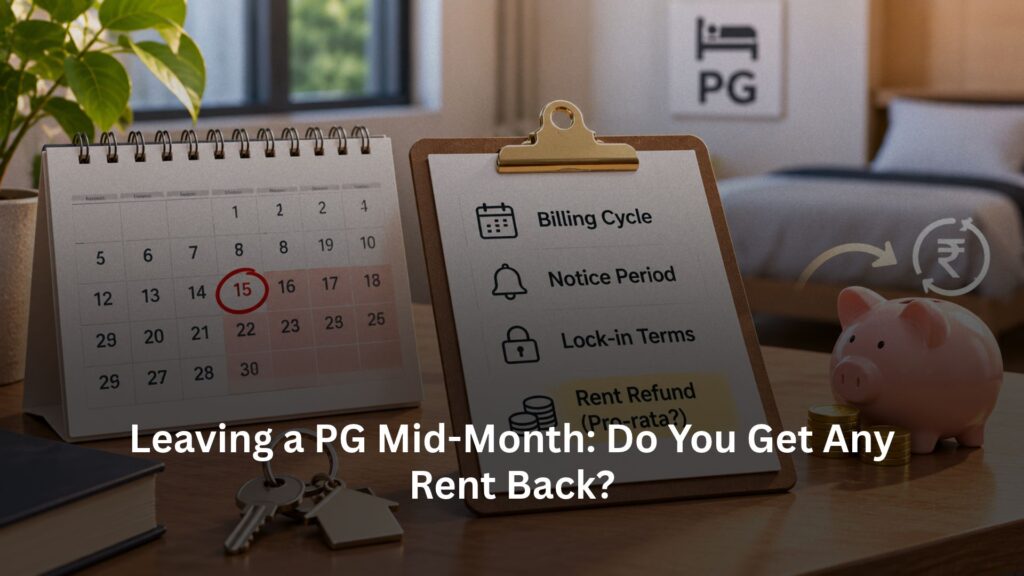
Leaving a PG Mid-Month: Do You Get Any Rent Back?
You paid for the month, but your new job, college timetable or next accommodation requires you to leave on the 15th. Getting half the rent back sounds reasonable. However, a PG rent refund mid month depends on when your payment liability ends, the agreed billing method, notice requirements and applicable law—not simply the day you pack your bags.
Start by separating three amounts: rent already paid, any rent still due, and your refundable security deposit. Leaving early does not automatically create a daily refund, but an operator’s “no refund” statement does not settle every legal question either. This guide explains the clauses to check, a practical pro-rata calculation and the written settlement to request before handover.
Does leaving on the 15th mean paying for only 15 days?
Not necessarily. A PG may bill by calendar month, a fixed cycle starting on your joining date, or an agreed daily calculation. Under a full-cycle arrangement, physically leaving halfway through the cycle may not end your obligation to pay for it. Check the agreed termination date and refund terms first.
There is no single nationwide PG rule guaranteeing half the rent back for a mid-month departure. Equally, do not assume that only an express refund clause can ever support recovery: applicable law, a later written settlement, the operator’s breach or the circumstances of termination may matter.
Distinguish a voluntary early move from the operator asking you to vacate. If management ends your stay or cannot provide the agreed accommodation, request a separate assessment of unused prepaid rent and other remedies. A general house rule does not necessarily answer that situation.
RentOK’s guide to PG agreement types explains why the actual arrangement matters. The label “PG” alone does not determine every right or obligation.
Common billing approaches you may encounter
Ask the manager to identify which approach your booking uses. There is no reliable national percentage showing how many PGs follow each model, so treat these as possible arrangements rather than a market-wide rule.
| Approach | What to clarify before leaving |
|---|---|
| Full calendar month | Whether an accepted mid-month termination creates any unused-rent credit |
| Joining-date billing cycle | The exact cycle end; the 15th may be your normal renewal date |
| Agreed daily calculation | The divisor, final chargeable day and treatment of bundled services |
For example, a cycle running from the 16th to the 15th differs from one running from the 1st to the 30th. The same physical departure date can therefore produce different settlements. Get the operator’s answer in writing before treating unused days as money recoverable.
Notice period and lock-in create different obligations
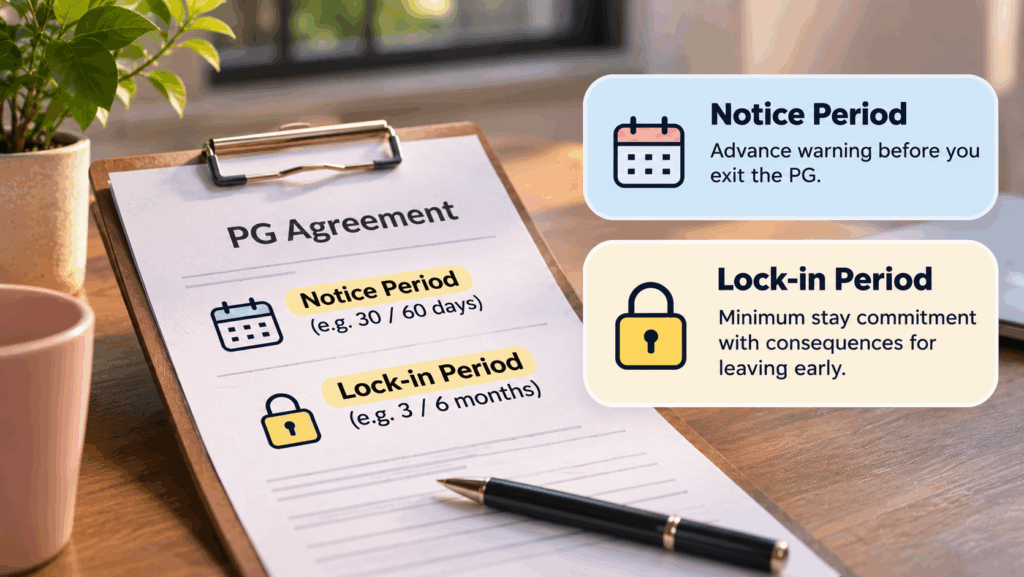
A notice period sets the advance warning required before an exit. A lock-in describes a minimum commitment, with specified consequences for leaving early. A 30- or 60-day notice period and a three- or six-month lock-in are possible contract terms, not universal Indian PG requirements.
If your contract requires 30 days’ notice, leaving 15 days after giving notice can create a shortfall. Ask whether rent continues through the notice end date or whether an agreed payment replaces the unserved period. Do not count the same covered days twice without questioning the basis.
Can the owner keep the whole deposit for breaking a lock-in?
Not automatically. Read the early-exit clause, permitted exceptions and whether notice can run during the lock-in. A transfer or medical emergency may support negotiation, but it does not automatically cancel contractual obligations.
For breach-related penalties, Section 74 of the Indian Contract Act, 1872 concerns reasonable compensation within the stipulated limit. A forfeiture clause does not make every demanded amount automatically recoverable. The legal treatment depends on the clause and facts; distinguish an ordinary rent debt from compensation for breach.
RentOK’s notice-period guide offers a useful framework for written notice and handover. Apply your PG’s relevant terms rather than importing a flat-rental example unchanged.

The agreement clauses that decide your starting position
Read the signed document alongside receipts, booking terms and any written changes the operator accepted. Look for the interaction between clauses rather than treating one sentence as the entire exit policy.
- Billing cycle: Identify the period your latest payment covers. “Monthly rent” alone may not explain whether the cycle follows calendar dates or your joining date.
- Early exit and pro rata: Check whether the operator calculates part-month charges, uses actual calendar days or a fixed divisor, and counts the handover day.
- Notice and lock-in: Record the required notice method, accepted notice date, expiry date, exceptions and any agreed early-release charge.
- Deposit settlement: Find the permitted deductions, inspection process, refund timeline and treatment of utility bills that arrive after handover.
- Meals and bundled services: Ask whether the package permits any adjustment. Not eating at the PG for two weeks does not, by itself, establish a separate food refund.
If you never received an agreement, preserve payment receipts, messages, joining forms and the house rules shared at booking. Missing paperwork complicates proof; it does not automatically erase either side’s rights. Ask the operator to identify the terms they rely on.
RentOK’s security-deposit refund guide explains why advance rent and a refundable deposit need separate accounting. Avoid accepting a single unexplained “balance forfeited” figure.
Pro-rata rent and the final settlement calculation
Pro rata rent means charging in proportion to the agreed chargeable days. Establish entitlement to that method before doing the arithmetic; a daily formula does not create a refund right on its own.
A worked November example
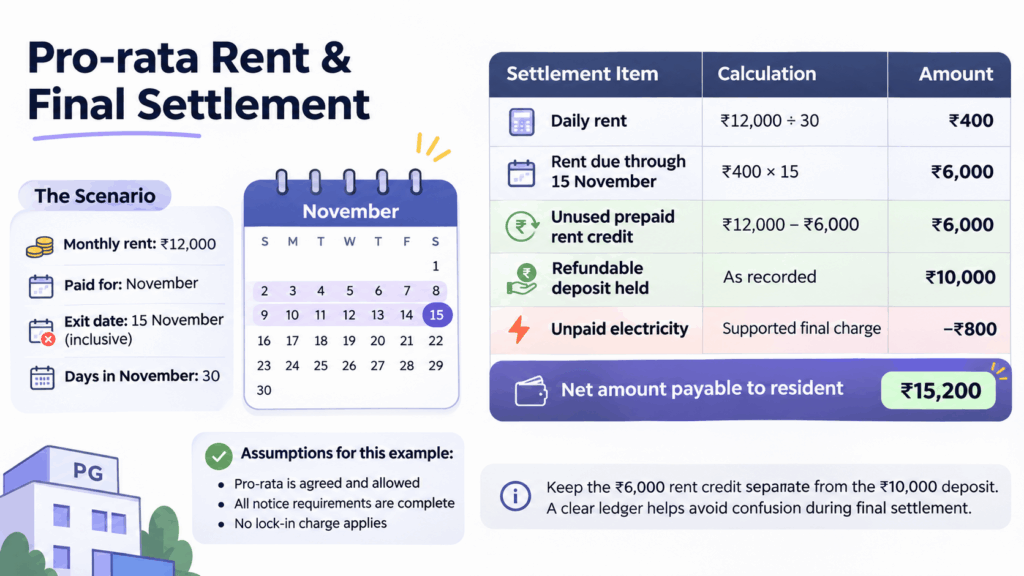
Assume monthly rent of ₹12,000, already paid for November, and an accepted end date of 15 November, inclusive. The parties agree to actual-calendar-day pro rata, all required notice is complete, and no lock-in charge applies. November has 30 days.
| Settlement item | Calculation | Amount |
|---|---|---|
| Daily rent | ₹12,000 ÷ 30 | ₹400 |
| Rent due through 15 November | ₹400 × 15 | ₹6,000 |
| Unused prepaid rent credit | ₹12,000 − ₹6,000 | ₹6,000 |
| Refundable deposit held | As recorded | ₹10,000 |
| Unpaid electricity | Supported final charge | −₹800 |
| Net amount payable to resident | ₹10,000 + ₹6,000 − ₹800 | ₹15,200 |
This example assumes no other legitimate deductions. A fixed 30-day divisor and actual-calendar-day division produce different results in a 31-day month, so confirm the method in writing.
Keep the ₹6,000 rent credit separate from the ₹10,000 deposit. That distinction prevents either amount from disappearing into an unclear adjustment. RentOK’s deposit-tracking guide shows why operators need a ledger connecting deposits, rent and final dues.

Negotiating an early exit without an unclear deduction
Approach the owner before committing to a handover date. Explain the reason, identify the contract position and propose a specific settlement. An agreed change works better than assuming a sympathetic conversation cancels rent.
Would a replacement resident help?
Offer to help find a suitable replacement, subject to the operator’s approval and normal onboarding. Ask whether an accepted replacement would end your liability earlier or reduce an early-exit charge. Record the replacement’s start date and the adjustment; finding someone does not automatically release you.
If the operator seeks vacancy-loss compensation after refilling the same bed, ask how the calculation accounts for the replacement. That fact may matter to a loss-based claim. It does not automatically settle every rent debt or termination charge.
Keep any waiver specific: identify whether it reduces notice rent, a lock-in claim or the remaining billing cycle. “We will adjust it later” leaves the amount unresolved. Ask the authorised manager to confirm the revised terms before relying on them.
A message you can send before leaving
“Hello [name], I am giving notice on [date] and requesting handover on [date] for bed/room [number]. Please confirm my contractual notice end date and whether you accept an earlier release. I request [pro-rata rent/a specified adjustment] for [period]. Please share the prepaid rent, deposit, itemised deductions, net settlement and payment date in writing before handover.”
If cash repayment is difficult, discuss a written deposit adjustment against agreed dues. Specify what it settles and the remaining refund. Do not stop paying rent or declare the deposit your last month’s payment without agreement; that can create a separate default dispute.
Evidence and handover protect the final balance
Before returning the keys, ask for a full-and-final settlement statement identifying the notice date, accepted end date, chargeable rent period, payments received, rent credit, deposit and each deduction. Confirm who owes whom, how payment will happen and when.
Photograph the room and inventory, take the final sub-meter reading, and save key or access-card handover confirmation. Compare any damage allegation with your move-in records. RentOK’s wear-and-tear guide explains why ordinary ageing differs from damage attributable to a resident.
If a utility bill remains pending, agree on a supported provisional holdback, a reconciliation date and release of the undisputed balance. Avoid an open-ended deduction for unspecified future bills. Keep your own copies after losing access to any resident account.
If the refund misses the agreed deadline, send a written demand with your calculation and evidence. RentOK’s guide to a withheld deposit explains practical escalation steps. The competent forum depends on location and the arrangement; seek local advice rather than assuming every PG dispute belongs before the same authority.

How RentOK helps settle PG dues digitally
A mid-month exit becomes harder when the deposit sits in a register, rent payments remain in chat screenshots and electricity charges arrive separately. RentOK helps operators organise resident records, payments, dues and deposit settlement information, giving the financial discussion a clearer starting point.
- Review payments and pending dues: Use the resident’s payment history and ledger to check what the operator has recorded. Match each amount to its billing period before calculating a refund or balance payable.
- Keep notice and occupancy visible: RentOK supports under-notice bed and room status. Maintaining the accepted exit information helps staff coordinate availability and avoid relying on separate verbal instructions.
- Reconcile deposits and adjustments: Review the deposit alongside supported dues and agreed credits. The operator must check the calculation and the contractual basis; software records do not decide whether a penalty or deduction is lawful.
- Retain a usable financial record: RentOK’s Money Reports provide reporting support for rental finances. Keep the agreed settlement statement and actual transfer evidence alongside the relevant records so both sides can follow the outcome.
Ask the property team which supported payment or refund process applies to your settlement. A recorded credit is not proof that money has reached your bank account, and using RentOK does not guarantee a disputed refund.
Conclusion
Leaving a PG mid-month does not automatically halve the rent. The useful question is when your payment liability ends under the agreement, applicable law and any accepted early-release terms. Check the notice and lock-in separately, confirm whether pro rata applies, and distinguish unused prepaid rent from the refundable deposit.
Start that conversation before handover, with dates and a proposed calculation. Request evidence for deductions, document the room and meter readings, and agree on a payment deadline. For operators, settle dues digitally with RentOK to keep payment records, deposit information and agreed adjustments organised around a clear final settlement.
FAQ
1. Will I get half my PG rent back if I leave on the 15th?
Not automatically. Check the billing cycle, accepted termination date and pro-rata terms, alongside applicable law. Leaving physically on the 15th does not necessarily end your payment liability that day, especially when a notice period remains unserved.
2. Is a 30-day notice period compulsory for every PG?
There is no universal 30-day rule for every PG in India. Your arrangement may specify a different period, subject to applicable law. Check how to give notice and obtain written confirmation of the accepted exit date.
3. Can I use my security deposit as the last month’s rent?
Use a deposit adjustment only with written agreement or another applicable legal basis. Confirm the amount, period covered and remaining balance. Unilaterally withholding rent because the operator holds your deposit can create a separate payment dispute.
4. Does breaking a lock-in mean losing the entire deposit?
Not necessarily. The clause, nature of the liability and applicable law matter; breach-related compensation is not automatically identical to the deposit. Request a calculation and supporting basis before accepting a blanket forfeiture as the final settlement.
5. How do I calculate daily rent for a PG refund?
First confirm that pro-rata charging applies and agree on the divisor. Actual-calendar-day calculation divides monthly rent by that month’s days, then multiplies by chargeable days; a contractual fixed divisor can produce a different amount in settlement.
6. What if the PG owner keeps delaying the refund?
Send a written demand identifying the agreed refund, deadline, handover date and supporting records. Ask for itemised deductions. If the dispute continues, seek advice on the appropriate local remedy rather than assuming one forum covers every PG.