
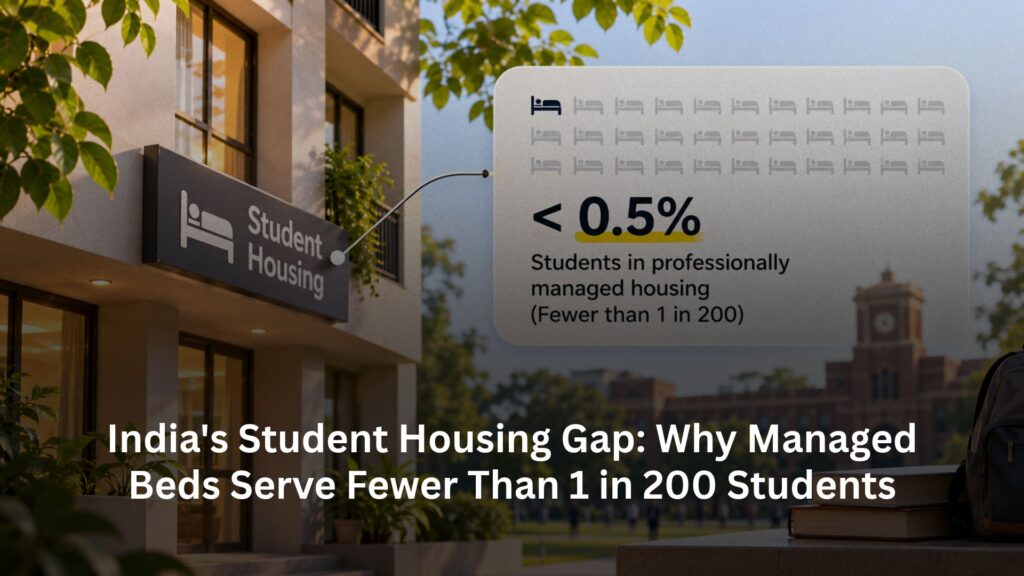
India’s Student Housing Gap: Why Managed Beds Serve Fewer Than 1 in 200 Students
India’s student-housing shortage concerns more than the number of rooms available. Students also need accommodation they can afford, a workable journey to college and services they can rely on. A bed in an overcrowded property and a properly operated student residence may both appear in the rental market, but they offer very different living conditions.
The “fewer than 1 in 200” figure describes the limited reach of professionally managed student accommodation, rather than all university hostels or private rentals. That distinction matters for anyone assessing student housing in India. The opportunity for PG owners lies in meeting a specific local need with suitable premises, realistic pricing and dependable management, not simply adding beds because a national shortage exists. This article uses sources checked on 5 November 2026.
What does “fewer than 1 in 200” actually measure?
CBRE’s August 2026 industry report, prepared for Elevate Campuses, estimates that professionally managed student accommodation serves less than 0.5% of higher-education enrolment. Its international comparison lists approximately 170,000–180,000 Indian PBSA/PMSA beds for 2024–25. These are industry estimates, rather than a government census of every rented student bed. See the CBRE report.
PBSA means purpose-built student accommodation. PMSA describes accommodation that a professional operator manages; the building need not have started life as a student residence. A university-owned hostel and a privately managed residence also belong to different supply categories.
The headline therefore does not mean that the remaining students have nowhere to live. Many stay with family, commute, occupy university hostels, share flats or rent local PG rooms. It measures one segment’s penetration, not homelessness or the safety of every alternative.
Different estimates describe different populations
The often-quoted 43.3 million students refers to AISHE 2021–22. The newer government release for AISHE 2023–24 reports 45 million, or 4.50 crore, higher-education enrolments.
| Measure | Figure and reference period | What it describes |
|---|---|---|
| Higher-education enrolment | 45 million; 2023–24 | All enrolments, including students who do not need rented accommodation |
| Professionally managed student beds | 170,000–180,000; 2024–25 estimate | CBRE’s PBSA/PMSA comparison |
| Student-living accommodation demand | About 12 million beds; 2025 estimate | Colliers’ estimate of accommodation needs |
| College and university accommodation | About 4 million students; 2021–22 capacity cited by Colliers | Institutional accommodation, not branded private inventory |
| Organised co-living inventory | About 300,000 beds; 2025 estimate | Housing for students and working professionals |
Colliers sets out the latter estimates in its May 2025 co-living release. They should not form one supposedly precise national balance sheet. In particular, 300,000 co-living beds are not 300,000 student-only beds, and different reference years limit direct comparisons.
DU’s hostel shortage makes the problem visible
Delhi University’s 2024–25 annual report lists 210,907 undergraduate students, 34,520 postgraduate students and 6,047 certificate or diploma students in its regular-student breakdown. Together, these total 251,474 – approximately 2.5 lakh.
September 2026 reporting counted 7,224 hostel beds across DU and its colleges. Hindustan Times reported that capacity.
Dividing those beds by regular enrolment gives roughly 2.9 hostel places per 100 students. This demonstrates limited institutional capacity, but it does not prove that the other 97 students all need a private bed. Local residents, commuters and accommodation eligibility affect actual demand.
For an operator, the useful question is where outstation students can find a suitable alternative. North Campus and South Campus have different catchments, travel patterns and neighbourhood choices. RentOK’s guide to PG areas near Delhi University explains why the exact college route matters more than a broad locality label.
A private PG can help fill that institutional gap. Its value depends on a safe building, a manageable commute and a service package students can sustain throughout the academic year.


Student mobility and changing expectations drive demand
Students who relocate create accommodation demand around particular institutions. A college’s reputation, course mix and intake can influence a neighbourhood more directly than a city’s overall population. Owners should study admission schedules and outstation enrolment rather than assuming every university expansion produces equal rental demand.
In a July 2023 study, Colliers estimated student relocation at around 11 million, projecting approximately 31 million by 2036. Treat that as a dated forecast, not a current headcount or guaranteed outcome.
The National Education Policy’s 50% gross-enrolment target for 2035 provides a longer-term policy backdrop. The government describes it as a target, and it includes pathways such as online and distance learning. Higher enrolment does not translate one-for-one into demand for physical hostel beds.
At property level, demand also depends on the offer:
- Total affordability: Families compare rent, meals, electricity, deposits and transport. A low advertised room rate can lose its appeal once compulsory extras appear.
- Everyday reliability: Working Wi-Fi, clean bathrooms, adequate water and prompt repairs directly affect study routines. Expensive amenities cannot compensate for unreliable basics.
- Predictable management: Clear visitor rules, payment terms and complaint handling help residents understand the arrangement before committing.
These needs create room for both purpose-built residences and smaller PGs that operate consistently within an affordable price range.
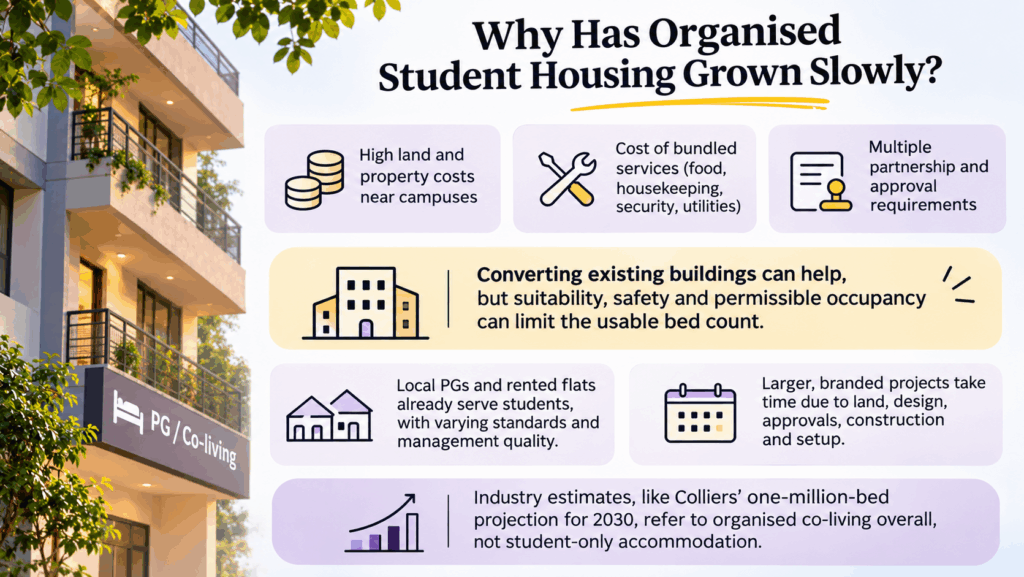
Why has organised supply expanded so slowly?
The shortage does not make every development commercially viable. Delivering accommodation involves securing a suitable property, funding the setup, obtaining relevant approvals and operating through changing occupancy. Several constraints reinforce one another.
Land costs and student budgets pull in different directions
Sites close to established campuses can be difficult to assemble or expensive to lease. A developer must recover land, construction, financing and operating costs from residents whose budgets have limits. A higher headline yield does not establish an acceptable payback period for a particular project.
Bundled services also have a real cost. Food, housekeeping, security, utilities and maintenance require staff and working capital. Students may choose a simpler room or arrange services separately when a managed package exceeds the family budget. That choice does not establish that they willingly accept unsafe housing.
For a first-time operator, separating property cost, furnishing, utility setup and cash reserves makes the decision clearer. RentOK’s PG-business setup guide provides a framework for organising those planning questions; obtain current local quotations for your own project.
Partnerships and permissions take time
An institutional partnership needs more than an available plot. The parties must establish authority over the land, permitted use, contractual rights, capital commitments and responsibility for operations. Institutions operating through trusts or other regulated structures may require additional approvals; the answer depends on their governing documents and applicable law.
Converting existing premises can reduce some development work, but conversion does not establish building suitability. Fire access, services, layout and permissible occupancy can limit the usable bed count. These checks affect both cost and launch timing.
Local supply is established, while larger projects need time to deliver
Local PGs and rented flats already serve students across many neighbourhoods. Their buildings, costs and management standards vary. Some operate responsibly; others need improvements or lack required approvals. It would be inaccurate to describe every independent PG as illegal or every branded residence as safe.
Larger projects face land acquisition, design, approval, construction and operational lead times. Institutional investment can support expansion, but capital commitments do not immediately become occupied beds. Acquisition, leasing, management and franchise arrangements can offer alternatives, each with its own control and execution risks.
Colliers’ one-million-bed projection for 2030 concerns organised co-living, not student-only accommodation. A forecast of growth therefore cannot establish that the student-housing shortage will disappear by that date.

Where can PG owners build a useful local offer?
The strongest opportunity is a specific gap in a campus catchment: a price point, room type or service standard that students need and existing properties do not deliver well. The national figures help explain the sector; local evidence must justify the property.
Start with the institution’s intake, hostel allocation and admission calendar. Visit competing PGs, compare complete charges and inspect the actual college journey. Repeat the exercise outside the admission rush, when a full building may reveal less about annual demand.
| Catchment or resident need | What an owner should test |
|---|---|
| Established university neighbourhood | Whether a compliant property can compete on total cost and walking distance |
| Developing campus cluster | Actual operating courses and intake, rather than announced future capacity |
| Students with tight budgets | Sharing arrangements that preserve permitted capacity, ventilation and usable space |
| Residents seeking dependable services | Whether the proposed rent can fund cleaning, repairs, utilities and staffing consistently |
Underwrite the operating model before adding beds
Prepare a budget that includes building rent or ownership costs, setup expenditure, recurring expenses and a working-capital reserve. Test lower occupancy, admission delays and vacancies between tenancies. Keep gross collections separate from operating surplus, and include financing costs when assessing cash available to the owner.
Avoid treating an “eight-million-bed gap” as eight million customers ready to pay your proposed rent. The rough difference between national demand and institutional capacity includes people who already use PGs, flats and other arrangements; it does not measure eight million immediately vacant market opportunities.
Keep reviewing the figures after opening. RentOK’s guide to tracking property income and expenses explains how property-wise records help owners assess performance beyond the collection total. A well-run small PG can address a local need without promising a fixed national-market return.
Existing requirements and proposed reforms need different treatment
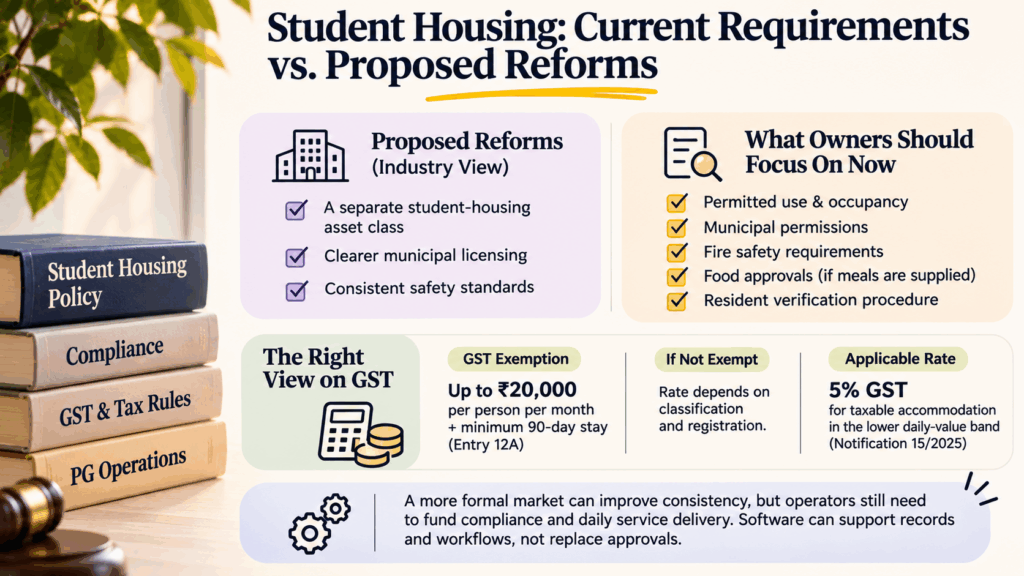
Industry calls for a distinct student-housing asset class, clearer municipal licensing and consistent safety standards could make development easier to assess. However, a policy recommendation does not become an operative national rule simply because an expert supports it. September 2026 industry discussion reported by The Economic Times sets out such proposals.
For owners, the immediate task is to establish the requirements already applicable to the premises. Check permitted use and occupancy, municipal permissions, relevant fire requirements, food approvals where meals are supplied, and the applicable resident-verification procedure. Local rules and the property’s actual activity determine the details.
RentOK’s Bengaluru PG-rules guide illustrates why a city-specific review matters. Do not transfer one city’s space, CCTV or staffing conditions to every PG in India.
Tax treatment also needs a precise reading
The supplied idea of an automatic 18% GST charge above a premium monthly-rent threshold needs correction. Entry 12A’s accommodation exemption requires a value of up to ₹20,000 per person per month and a minimum continuous 90-day stay, as CBIC explains.
Outside that exemption, classification, registration and the relevant rate entry matter. Taxable accommodation within the lower daily-value band currently attracts 5% total GST, following the September 2025 change; it does not automatically attract 18% merely because the monthly figure exceeds ₹20,000. See Notification 15/2025.
A more formal market may improve consistency, but operators still need to fund compliance and daily service delivery. Software can support records and workflows; it cannot turn unsuitable premises into approved student housing.
How RentOK helps you start and manage a student PG
Turning accommodation demand into a dependable student residence requires control over beds, admissions, payments and everyday issues. RentOK helps organise those operating workflows, so an owner can manage the property with clearer information from the first admissions onward.
- Keep room and bed availability visible: Record rooms, sharing types and occupied, vacant or under-notice beds. This helps staff answer enquiries against the property’s actual availability.
- Organise enquiries and admissions: Track leads, schedule visits and maintain resident details. A defined workflow helps the team handle the admission season without relying on scattered personal messages.
- Set up rent and payment records: Recurring dues, reminders, payment links and tenant ledgers help owners explain charges and follow up on outstanding amounts. Clear records also support questions from residents and parents.
- Track maintenance requests: Centralised complaints and task assignment help staff follow an issue through to resolution. RentOK’s maintenance-request guide explains why reporting, responsibility and updates need to stay connected.
- Review financial performance: Income, expense and dues reports help owners compare collections with operating costs and identify where the property needs attention.
Use these tools alongside approved capacity, appropriate permissions and clear resident agreements. A digital system supports professional management; the owner remains responsible for the premises and the services promised.
Conclusion
The student-housing gap in India creates demand for more than additional beds. It creates a need for accommodation that combines affordability, a workable college journey, suitable premises and dependable services. The “fewer than 1 in 200” estimate shows the limited reach of a defined professionally managed segment, while DU demonstrates how restricted institutional capacity can shape a local rental market.
PG owners can respond by building an offer around verified local demand and costs they can sustain. Establish the property’s suitability, price the full service honestly and put daily operating records in place before admissions grow. Start your PG with RentOK and organise the beds, payments and service workflows that help turn a room offer into a well-managed student residence.
FAQ
1. Does the “fewer than 1 in 200” figure include every university hostel?
No. The figure refers to a defined professionally managed student-accommodation segment, not all student housing. University hostels, family homes, shared flats and local PGs house many students outside that category, so the figure does not measure homelessness.
2. Are India’s 300,000 organised co-living beds all for students?
No. Colliers’ 2025 estimate covers co-living for students and working professionals. Treating every bed as student accommodation mixes two markets and can produce a misleading percentage when you compare that inventory with higher-education enrolment.
3. Does DU’s limited hostel capacity guarantee demand for a new PG?
It does not guarantee occupancy. Demand depends on the college catchment, student budgets, transport, competing accommodation and your property’s offer. Check those conditions locally before committing to a lease, renovation or additional bed capacity.
4. Must a managed student residence be a purpose-built building?
Not necessarily. Professional management and purpose-built construction describe different things. An existing property may support student accommodation when its permitted use, layout, approvals and operating arrangements suit the activity; conversion alone does not establish compliance.
5. Can an independent PG compete with a large student-housing brand?
Yes, through a suitable local offer. A compliant property with transparent charges, reliable basic services and a convenient college journey can meet student needs. Its economics still depend on actual costs, occupancy and service delivery.
6. Will new student-housing rules apply uniformly across India?
Do not assume a single nationwide PG rulebook. Existing requirements depend on the location and activity, while proposed reforms need formal adoption. Check operative notifications and approvals before treating an industry recommendation as a legal requirement.